

-
10 min read
Apr 6, 2026 5:36:34 PM
.png?height=420&name=RH%20Snapshot%20(3).png)
Share On:

Many investors wonder whether selling real estate in a down market is a mistake. In practice, experienced operators focus less on timing and more on execution, value creation, and what the exit enables next. A disciplined real estate exit strategy is not about chasing peak pricing. It is about realizing gains and positioning capital for what comes next.
Key Takeaways
- Selling below peak pricing does not mean an investment underperformed
- Value creation during the hold period matters more than exit timing
- Realized gains and liquidity often outweigh waiting for uncertain market recovery
- Down markets can create better forward opportunities for reinvestment
- Risk management and capital preservation are often key drivers behind strategic exits
- Clear investor communication helps align expectations with real outcomes
Why This Matters Now
Markets have shifted. Cap rates have expanded, debt costs have increased, and many investors are pausing decisions while waiting for clarity. The question is no longer whether the market is at its peak, but whether your capital is positioned to move forward effectively.
The Myth: Why Investors Fear Down Market Sales
There is a natural tendency to anchor to the highest perceived value of an asset. If a property could have sold for more a year or two ago, anything less is often perceived as a loss, even when the investment has performed well.
This is where many investors get stuck. They confuse unrealized peak value with actual performance. They focus on what might have been instead of what has been achieved.
Consider an investor who purchased an asset at 8 million and saw it reach a theoretical value of 14 million at peak conditions. If the market shifts and the asset sells for 13 million, it is often perceived as a loss. In reality, the investment still produced meaningful gains. The difference is psychological, not economic.
Reframing the Question
A more grounded approach is to shift the question entirely.
Instead of asking, “Is this the best possible market to sell?” a more useful question is, “Have we executed the business plan, and what does this capital allow us to do next?”
This reframing removes the need to predict market tops. It centers the decision on what is controllable. Execution, value creation, and forward opportunity.
An experienced investor is less concerned with capturing the final increment of value and more focused on preserving gains and maintaining flexibility.
Case Study: A 128 Unit Apartment Community
In 2021, a 128 unit apartment community was acquired through an off market opportunity tied to a complex family legal situation. The property was purchased for approximately 8 million, or about 60,000 per unit.
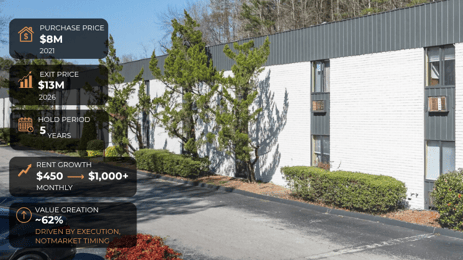
At acquisition, the asset was significantly under-optimized. The property had been owned by the same family since 1980, with a focus on maintaining occupancy, employing family members, and keeping rents low. As a result, operations were stable, but performance lagged the market.
Average rents were around 450 dollars, well below comparable properties, and there was meaningful opportunity to improve both operations and the physical asset.
This was not a turnaround. It was an execution opportunity.
Over the next five years, the focus remained consistent. Execute the plan.
The exterior was repainted. The roof was replaced. Parking areas were improved. Approximately 90 percent of the units were renovated, including reconfigured kitchens, new appliances, updated finishes, and improved layouts.
Common areas were addressed. A persistent hallway airflow and odor issue was solved through system upgrades and new materials. These changes improved both resident experience and operational efficiency.
As a result, rents increased meaningfully. Studio units moved to approximately 1,000 dollars. One bedroom units reached approximately 1,100 dollars. The asset stabilized at a higher level of performance and began operating in line with the broader market.
The Exit in a “Down Market”
In 2026, the property was sold for approximately 13 million dollars.
At the time, market conditions were not considered peak. Cap rates had expanded into the 6 to 6.5 percent range. Many investors would describe this as a down market relative to prior years.
Yet the outcome tells a different story.
The investment moved from an 8 million dollar basis to a 13 million dollar exit. The business plan was executed. Capital was returned along with profit. The value created during the hold period was realized.
This outcome was not reliant on market appreciation. It was driven by execution.
A Win Without Perfect Timing
It is easy to assume that the only successful exit is one that happens at the exact top of the market. In practice, that is rarely how experienced investors operate.
This investment did not require perfect timing. It required disciplined execution and a clear understanding of when the plan had been fulfilled.
The spread between basis and exit was strong. The operational improvements were proven. The gains were real and realized, not theoretical.
Timing can influence IRR, but execution is what ultimately drives total return and equity multiple. That is what defines a successful outcome.
The Strategic Advantage of Selling in a Down Market
Selling in a softer market can create advantages that are often overlooked.
First, it allows investors to take chips off the table. Realized gains reduce exposure and create certainty.
Second, it resets the cost basis. Capital can be redeployed into assets that are now priced more conservatively. In some cases, new opportunities may be available at 20 to 30 percent below prior peak pricing.
Third, it increases optionality. When others are constrained by financing challenges or waiting on the sidelines, liquidity becomes a competitive advantage.
For example, an investor who exits and holds liquidity can pursue distressed opportunities, negotiate better terms, or selectively reenter the market with improved positioning. An investor who waits for perfect timing may find themselves holding an asset while missing the next cycle of opportunity.

The Often Overlooked Driver: Risk Management
Not every sale is about maximizing upside. In many cases, it is about managing downside risk.
Market conditions change. Debt structures reset. Capital expenditures can increase. Holding longer introduces new variables that were not present when the investment was underwritten.
For example, rising interest rates can create refinancing pressure. Debt maturities may require new equity or expose the asset to less favorable terms. Deferred capital needs can increase future investment requirements.
A disciplined exit recognizes when the majority of the business plan has been executed and when additional upside may come with disproportionate risk.
Selling in this context is not reactive. It is a proactive decision to protect capital and preserve gains.
Investor Alignment and Expectation Setting
One of the challenges in down market exits is not performance. It is perception.
Investors often compare outcomes to peak valuations they have seen or heard about. Without context, a strong result can feel underwhelming simply because it was not maximized against a prior high.
This is where communication matters.
Clear, consistent communication helps investors understand what defines success. It reinforces that realized returns, capital preservation, and forward positioning are the true benchmarks.
For example, returning capital with a strong gain and the ability to reinvest into better opportunities can be far more valuable than holding out for marginal additional upside.
Alignment around these principles builds long term trust.
What Most Investors Miss
Many investors wait for ideal conditions that never fully materialize. They hold assets longer than planned, hoping for incremental gains, while the market environment continues to shift.
Markets move in cycles. The ability to adapt matters more than predicting turning points.
Value is created during the hold period through execution. The exit simply converts that value into realized returns.
Liquidity is not just an outcome. It is a strategic tool.
Closing Perspective
Selling in a down market is not a sign of failure. It is often a reflection of discipline and clarity.
The goal is not to sell at the exact top. The goal is to execute the plan, protect and grow capital, and position for what comes next.
When viewed through that lens, the question changes.
It is no longer about whether the timing was perfect. It is about whether the investment did what it was intended to do, and whether the investor is now better positioned moving forward.
Frequently Asked Question
Is it a bad idea to sell real estate in a down market?
Not necessarily. Selling real estate in a down market can still produce strong results if the investment has achieved its business plan and created meaningful value. In many cases, a disciplined exit allows investors to realize gains, reduce risk, and redeploy capital into better opportunities, which can be more important than waiting for uncertain market recovery.
Should I wait for the market to recover before selling?
Not always. Waiting for recovery assumes you can time the market correctly, which is rarely consistent. If the business plan is complete and capital can be redeployed into stronger opportunities, selling may be the more disciplined decision.
How do I know when it is the right time to sell an investment property?
The right time to sell is typically when the original business plan has been achieved, risk begins to increase relative to potential upside, and there are better opportunities available for the capital. It is a strategic decision, not a market prediction.
.png)

.png)

The Quattro Team is passionate about helping investors achieve financial freedom through smart asset backed investments. We combine deep market knowledge with a people-first approach to create wealth and impact for our partners and communities.
Comments