

-
10 min read
Dec 5, 2025 1:34:56 PM
.png?height=420&name=Blog%20%20Images%20(3).png)
Share On:

A Measurement Focused Guide for Today's Income Investors
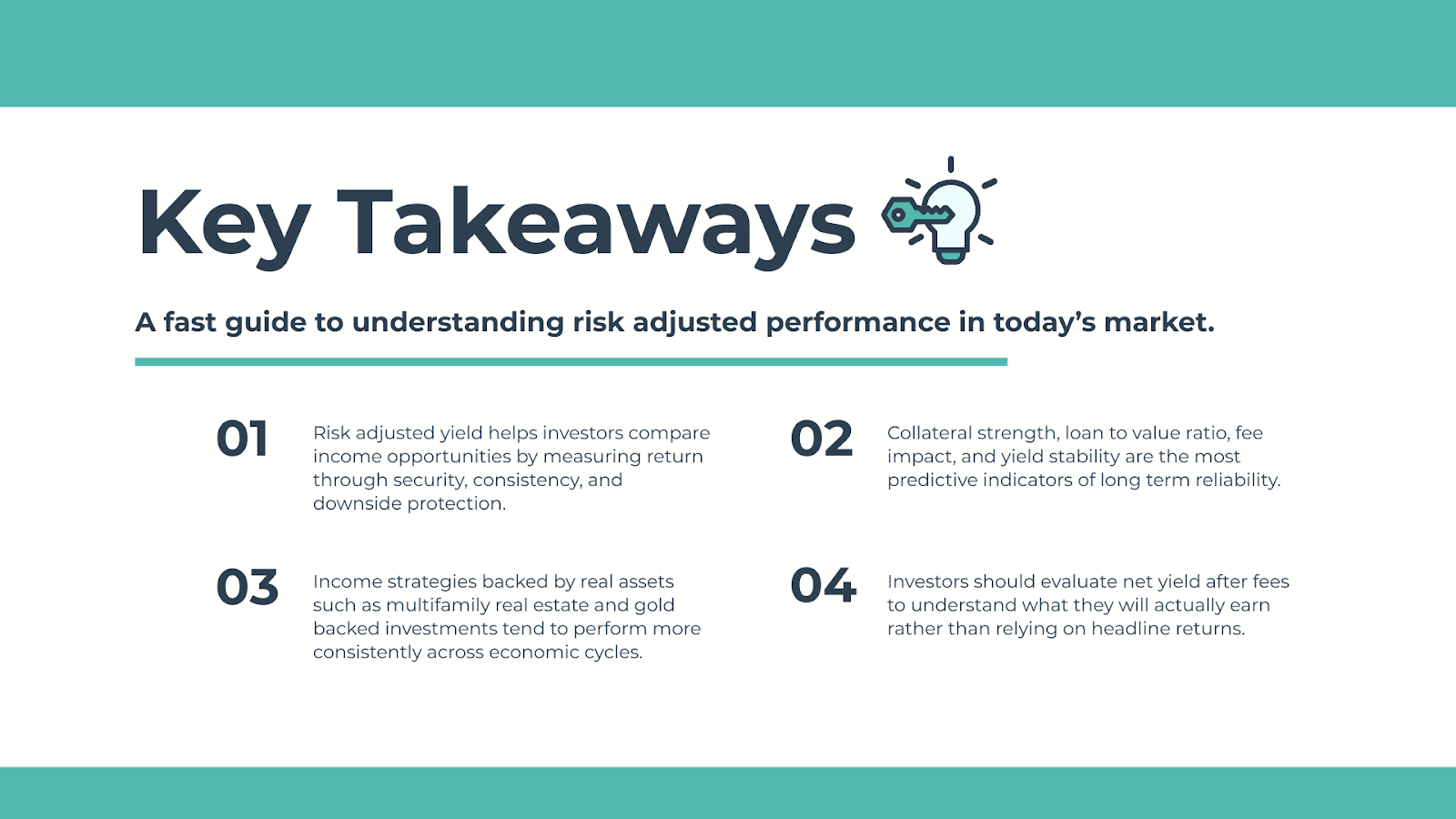
Most income investors focus on the headline number. A fund offering ten percent or twelve percent may appear attractive in a high rate environment. Yet the advertised yield tells you very little about the true return you can expect or the strength of the protection behind it. Investors who want to evaluate fixed income funds effectively must understand how stable the return is and how well it is supported by measurable fundamentals.
This is where risk adjusted yield becomes the essential measurement. Strong performance is not just about what you earn. It is about how the return is created, how resilient it is, and how predictably it behaves over time. Risk adjusted yield helps investors distinguish between the appearance of yield and the reality of secure income.
Quattro designed the Quattro Fixed Income Fund II with these measurements at the center. Asset backed collateral, disciplined loan to value ratios, and a zero fee structure provide measurable protection that supports long term stability. This guide gives investors a clear way to assess risk adjusted yield and compare income opportunities with clarity.
What is Risk Adjusted Yield and Why Does It Matter
Risk adjusted yield measures how much true return an investor earns after considering collateral strength, volatility, fees, and downside protection. The headline number may be the same across many offerings, but the real return can differ widely once stability and risk exposure are taken into account.
Real world example
Two investments may both offer ten percent. One is unsecured and depends on market conditions. The other is backed by multifamily real estate and gold backed positions with a strong equity buffer. Both look identical at first glance. Only one is built on a reliable foundation.
Understanding these differences allows investors to compare income strategies based on measurable fundamentals.
How Do You Measure the Safety of a Fixed Income Fund
Investors can evaluate safety and stability by examining seven key inputs. These metrics help determine whether a fund’s return is supported by disciplined structure or inflated by risk.
1. Collateral Strength
Collateral strength is the foundation of any secured income strategy. Investors evaluating income funds should ask what backs the notes or positions inside the fund. Unsecured obligations and corporate debt tend to fluctuate with economic changes. Real assets such as multifamily housing and gold backed investments provide tangible security that holds value across cycles.
Why collateral matters in real conditions
When inflation rises or borrowing costs shift, real assets historically retain value more effectively than unsecured financial instruments. This is why secured lending built on real assets typically shows higher recovery potential and stronger yield consistency.
2. Loan to Value Ratio
Loan to value, or LTV, is one of the clearest predictors of downside protection. It compares the size of the loan to the value of the underlying asset. Lower LTV means more equity protection and greater resilience during market changes.
Scenario: LTV in action
Imagine two loans. One is at ninety percent LTV. The other is at sixty five percent LTV. If market values soften, the ninety percent loan has almost no buffer, which increases investor risk. The sixty five percent loan has a thirty five percent equity cushion that protects investor capital and improves recovery reliability.
Strong LTV is one of the most important measurements for secured income strategies.
3. Fee Drag
Fee drag refers to the difference between the advertised yield and the net yield that investors actually receive. Many funds charge management fees, performance fees, or administrative fees that reduce returns.
Why this matters
A ten percent advertised return reduced by a two percent fee produces eight percent net. Over a three year term, that fee structure can reduce total earnings by thousands of dollars. Investors searching for how to measure fund performance should always calculate yield after fees rather than relying on the headline number.
A zero fee structure significantly improves the accuracy of your yield and is a key reason Quattro designed QFIF II without management fees.
4. Yield Consistency
Yield consistency is a direct measurement of reliability. A fund that delivers one strong year followed by weaker or inconsistent years indicates underlying volatility. Investors should look at how stable the yield has been across time, not just the average return.
Why this matters in real investing
Evaluating consistency is more valuable than evaluating a single peak year. Investors who want predictable income often prioritize stability over occasional spikes. Standard deviation, though not always directly reported, is a helpful way to understand variability when examining yield history.
5. Default Protection
Default protection outlines how insulated your capital is when a borrower or asset underperforms. Strong protection may include collateral control, personal guarantees, seniority of position, and predetermined remedies in the event of default.
Secured lending strategies tend to perform more consistently during periods of economic stress because the underlying collateral provides measurable recovery potential. Evaluating default protection is a core part of understanding risk adjusted yield.
6. Liquidity and Lockout Structure
Liquidity needs vary from investor to investor. Some want immediate access to capital even when that access will not be used. This often leads to a behavioral yield gap where investors accept lower yield for liquidity they never require.
Scenario: The liquidity tradeoff
An investor chooses a five percent liquid fund because they want access but then leaves the money untouched for several years. Over that same period, a structured income fund offering eight to twelve percent could have significantly increased total return while still aligning with long term goals.
Measuring true liquidity needs helps investors choose income vehicles that support their financial plan more effectively.
7. Transparency and Reporting
Transparency is a measurable sign of trustworthiness. Investors should look for managers who provide regular reporting, asset level information, clear underwriting standards, and open access to data. Strong transparency reflects strong operational discipline and alignment with investors.
Which Metrics Predict Long Term Income Stability
A data driven approach helps investors compare opportunities with clarity. Before selecting a fund, evaluate:
- The collateral and whether it holds value through economic cycles
- The loan to value ratio and the strength of the equity buffer
- The net yield after fees
- The consistency of historical yield
- The level of default protection and collateral control
- The liquidity structure and whether it matches your goals
- The transparency and accessibility of information
This checklist allows investors to focus on the measurements that influence stability and long term performance.
Why This Matters Now
Today’s market is shaped by shifting rate expectations, slower growth, and more cautious lending standards. Investors are searching for income strategies that provide predictability and measurable protection. Risk adjusted yield gives investors an objective way to evaluate opportunities in a cycle where stability and secured structure matter more than ever.
Conclusion
Risk adjusted yield is the most reliable way to evaluate fixed income opportunities in today’s environment. It replaces guesswork with measurable insight and helps investors compare funds based on security, consistency, and true performance. When investors understand how collateral strength, loan to value, fee structure, and yield history shape real returns, they are better equipped to make decisions that support long term financial stability.
Closing scenario
Imagine two investors who both select a ten percent fund. One invests in a structure with high fees, minimal collateral, and inconsistent performance. The other invests in a secured income strategy backed by real assets and measurable protections. Only one of those investors will feel confident during rate changes and economic shifts. Risk adjusted yield reveals which path creates stability that compounds over time.
Quattro remains committed to building income strategies rooted in clarity, protection, and measurable performance. If you would like help evaluating whether secured fixed income belongs in your portfolio, our team is here to support your decision making with objective data and thoughtful planning.
FAQ: Measuring Risk Adjusted Yield in Fixed Income Funds
What is risk adjusted yield in fixed income investing?
Risk adjusted yield measures how much true return an investor earns after accounting for collateral strength, volatility, fees, and downside protection. It focuses on the reliability of the income stream rather than the headline number.
How do I evaluate the safety of a fixed income fund?
Evaluate safety by examining collateral quality, loan to value ratio, default protection mechanisms, yield consistency, and the transparency of the manager. These measurements show how well supported the fund’s performance is.
What is a good loan to value ratio for secured income investments?
A strong loan to value ratio maintains a meaningful equity buffer. Lower LTV ratios typically provide higher recovery potential in the event of a downturn. Investors should always request the LTV position before investing.
How do fees impact my real return in a fixed income fund?
Fees reduce net yield. Even small fees can significantly reduce compounded earnings over time. Funds with minimal or no fees typically deliver more accurate and consistent net performance.
Are real asset backed income funds more stable during rate changes?
Yes. Real asset backed funds tend to remain more stable because the collateral retains intrinsic value across economic cycles. Strategies backed by multifamily real estate or gold backed investments often show higher consistency during periods of rate fluctuation.
Learn More About QFIF II

.png)

.png)

The Quattro Team is passionate about helping investors achieve financial freedom through smart asset backed investments. We combine deep market knowledge with a people-first approach to create wealth and impact for our partners and communities.
Comments